In the competitive world of soccer, a coach's ability to motivate their players is crucial for the team's success. Beyond game strategies and physical training, motivation plays a decisive role in player performance. Whether it's the pre-match talk, post-match debrief and critiques, or even collective and individual speeches, motivating players requires a certain rigor.
This article explores effective methods to inspire and motivate a soccer team as a coach. From the coach's stance to the most impactful motivational levers, and the mistakes to avoid in daily communication, understanding these elements can transform a team's dynamics and thus the club's results.
- What stance should you take to motivate your players?
- What levers should you use to motivate your players?
- Mistakes to avoid when speaking to your players
- Examples of professional coaches' speeches
What stance should you take to motivate your players?
A coach's stance is fundamental to effectively motivate their players, both in good times and bad. A coach must embody confidence, not only through words but also through body language, behavior, and posture. An open stance, direct eye contact, and a confident tone of voice help establish a climate of trust with the players.
A coach who is not demonstrative and lacks true posture will provide no compass for the entire team, potentially impacting team spirit and thus the club's results. Every coach must show enthusiasm and passion for the game, the club, the supporters, and must be able to take responsibility in key moments, such as during the halftime talk.
Among them:
- Substituting players at a key moment in a match
- Delivering a speech that may initially seem harsh but is essential to change the philosophy of a match
- Conducting individual interviews with players in problematic situations
- Taking responsibility for the club's sports results in front of management and players
The coach must also be an excellent communicator, able to clearly convey ideas and strategies. Effective communication involves listening to players, understanding their needs and concerns, and responding constructively. It is important to create an emotional connection with the players by knowing them individually and genuinely caring about their development both on and off the field. Hence the importance of choosing the right captain to have a relay among the players.
Finally, the ability to inspire is also crucial for any coach. This involves setting clear and achievable goals throughout each season, celebrating successes (even the smallest ones), knowing how to question strategy and vision of the game at a given moment, etc. The coach is therefore, through their daily stance, the beacon of the entire locker room and more broadly of a club.
Progress with our drills
Access 500+ premium drills with diagrams inspired by pro coaches. New drills every week.

What levers should you use to motivate your players?
Knowing how to set the right goals as a coach
To effectively motivate a soccer team and each player with their personality, it is crucial to master different motivational levers. One of the fundamental aspects is setting clear and achievable goals, both collective and especially personalized and individual.
Goals should be specific, measurable, achievable, realistic, and time-bound (SMART). This will help you as a coach to gain perspective on possible and concrete levers to motivate your players but will especially help players to project themselves and reconnect with motivation in the short and medium term.
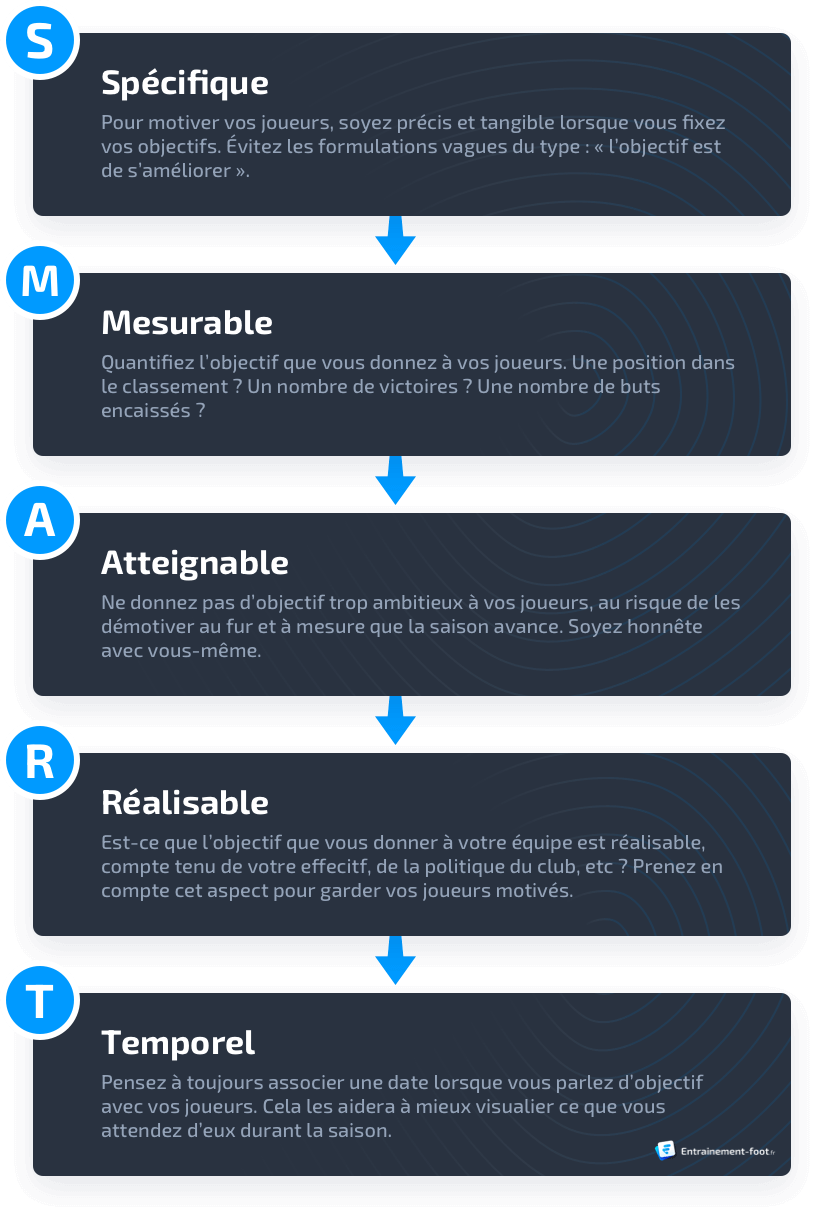
The S.M.A.R.T method to motivate players
Knowing how to recognize efforts and performances
Recognizing players' efforts and performances is also a powerful motivation driver. Celebrating small victories and acknowledging improvements, even minor ones, can increase players' confidence and commitment. Recognition towards one or more players should be felt both in the coach's speech and in matches and training sessions with more responsibilities, playing time, etc.
Creating a virtuous environment within the locker room
Creating a positive and inclusive team environment is also essential in any team. This involves promoting group cohesion, mutual assistance, and creating a culture where each player feels valued and important for the team's collective success.
Take, for example, the time during less intense periods (winter or summer break) to meet with your players, engage in more atypical activities and training sessions to create collective moments within the group.
Progress with our drills
Access 500+ premium drills with diagrams inspired by pro coaches. New drills every week.
Mistakes to avoid when speaking to your players
When aiming to strengthen the motivation of your team and players, certain mistakes should be avoided, particularly in the speech delivered. Some can even counteract your initial goal and demotivate certain players. Here are the main mistakes to avoid:
- Lack of clarity and consistency: A vague or contradictory speech can create confusion and reduce players' trust in the coach. This can be about the strategy and game setup during matches, the starting lineup, etc.
- Excessive negativity: While constructive criticism is necessary, too much negativity can significantly demoralize players. It is important to find a balance between negative and positive feedback, even during periods of doubt and more challenging times when sports results are not there. Again, every progress, even minor, should be highlighted and emphasized to progress collectively.
- Ignoring players' needs: Not considering players' feelings, concerns, injuries, or suggestions can lead to a sense of disconnection and dissatisfaction. Take the time to listen to your players and consider their feedback. Their trust and motivation will only be stronger.
- Lack of flexibility: Rigidly sticking to a plan or strategy without adapting to circumstances or players' needs can lead to continuous failures and real collective frustration.
- Responding systematically by increasing training workload: Imposing more work or intensifying training when a player is struggling or stagnating can lead to overtraining rather than improvement. A personalized approach, focused on quality rather than quantity, is often more effective.
Examples of professional coaches' speeches
Speeches by coaches at the highest level of soccer offer inspiring examples of ways to motivate players, no matter the moment. These speeches are often characterized by their ability to galvanize players, strengthen team confidence, and encourage perseverance, in victory and defeat.
Progress with our drills
Access 500+ premium drills with diagrams inspired by pro coaches. New drills every week.
A prime example of a speech is that of Pep Guardiola, known for his tactical approach and ability to inspire his players. His speeches often combine a sharp tactical analysis with personal messages, showing his confidence in each player's abilities.
Another notable example in France is that of Pascal Dupraz in 2016, allowing Toulouse Football Club (TFC) to remain in Ligue 1 during the last day of the championship, while being behind at halftime. A moment rich in emotion illustrating the importance of a coach's speech and stance in front of their players to reconnect with motivation and change the outcome of a match.