At this age, every training session is an opportunity to spark the desire to play while laying the technical foundations. Here is a complete guide to structuring effective sessions adapted to beginners.
Understanding the U6–U7 categories
U6 and U7 categories correspond to children’s first steps in football. At this age, the main objective is not performance, but discovery, enjoyment, and the overall development of the child.

Young players have a limited attention span, coordination that is still developing, and a constant need for movement. Training must therefore be designed as a dynamic, fast-paced, and fun moment.
At this age, football becomes an educational tool. The coach plays a central role in:
- Making children want to come back to training
- Creating a positive and safe environment
- Encouraging early collective interactions
A successful U6–U7 session is above all a session where children have fun while learning without realizing it.
The ideal structure of a U6–U7 session
A U6–U7 session must be simple, short, and highly dynamic. The structure should allow alternating activity phases to maintain children’s attention.
The organization we generally recommend to our subscribed coaches is based on 3 to 4 main phases:
1. Fun warm-up
The start of the session must immediately capture attention. This is not a traditional warm-up, but rather a simple game with or without the ball.
The objective is to get children moving quickly while creating a positive atmosphere.
2. Simple technical activities
Exercises must be short, varied, and accessible. Each child must be active, with little waiting time.
We favor situations where:
- Each player has a ball
- Instructions are simple and visual
- The coach demonstrates more than explains
At this age, repetition comes through play, not constraint.
3. Small-sided games
Play is at the heart of the session. Formats such as 2vs2, 3vs3, or 4vs4 are ideal to encourage contact with the ball.
These situations naturally allow work on:
- Awareness
- Movement
- First collective notions
4. Cool-down
The end of the session should be a calmer moment, often in the form of a small game or discussion.
It is also the moment to praise the children and reinforce their motivation.
Typical U6–U7 session (60 min)
This U6–U7 session aims to develop dribbling through dynamic and accessible situations adapted to young players. The objective is to increase ball contacts while promoting enjoyment and engagement. It concludes with a fun small-sided game.
Work on dribbling and finish with a fun small-sided game
This session focuses on dribbling, an essential skill to develop from an early age. Through simple and fun situations, players will learn to control the ball while staying in motion. The session ends with a dynamic small-sided game to apply what has been learned in a realistic context.
#1 Warm-up: sequence, control, dribbling, and passing
- The player dribbles the ball through the course and makes a pass at the exit of the 4 cones to another player positioned at the 2nd gate.
- The latter controls the ball, continues the course through the 3rd gate, and makes a pass just after the 4 cones to another player waiting at the 4th gate.
- The drill continues in the same manner afterward.
Variation: to develop this warm-up exercise, you will ask your players to continue their run after exiting the slalom while dribbling to pass through the gate, then make a pass into the path of their teammate (see animation below).

Emphasize the precision of the 2 successive sequences dribble-pass and pass-control. Don't forget to remind your players that the ball must be struck and not pushed when making the pass. It is at a young age that players will develop their basic technical skills.
Themes linked to this drill
#2 Dribbling under pressure: "The Robbers"
- The 1st player of each team starts at your signal. He/She must get to the square as quickly as possible and then return dribbling with a ball into their zone.
- Upon arrival, the 2nd player can start to perform the same route.
- The team that has brought the most balls into their zone at the end wins the round.
- Conduct several rounds depending on the number of players present.
Themes linked to this drill
#3 Tic-Tac-Toe possession game with overload
Themes linked to this drill
#4 Passing game with target zones in 4v4
When a player scores a goal, the player involved temporarily leaves the game to attempt a long ball into the opposing zone. The balls are initially placed in the center of the field. Once a ball leaves the central zone, it can only be played again after all other balls have been sent into a zone. The game stops when all the balls have been distributed into the two zones.
- Free play 4 vs 4.
- A player can temporarily leave to attempt a pass into the opposing zone, only after a goal.
- The match stops when all the balls are in a zone.
Progression
Objectives
- Improve the quality and accuracy of passing.
- Encourage game awareness before passing.
- Work on vision and skill execution under pressure.
- Have fun with a fun game.
Themes linked to this drill
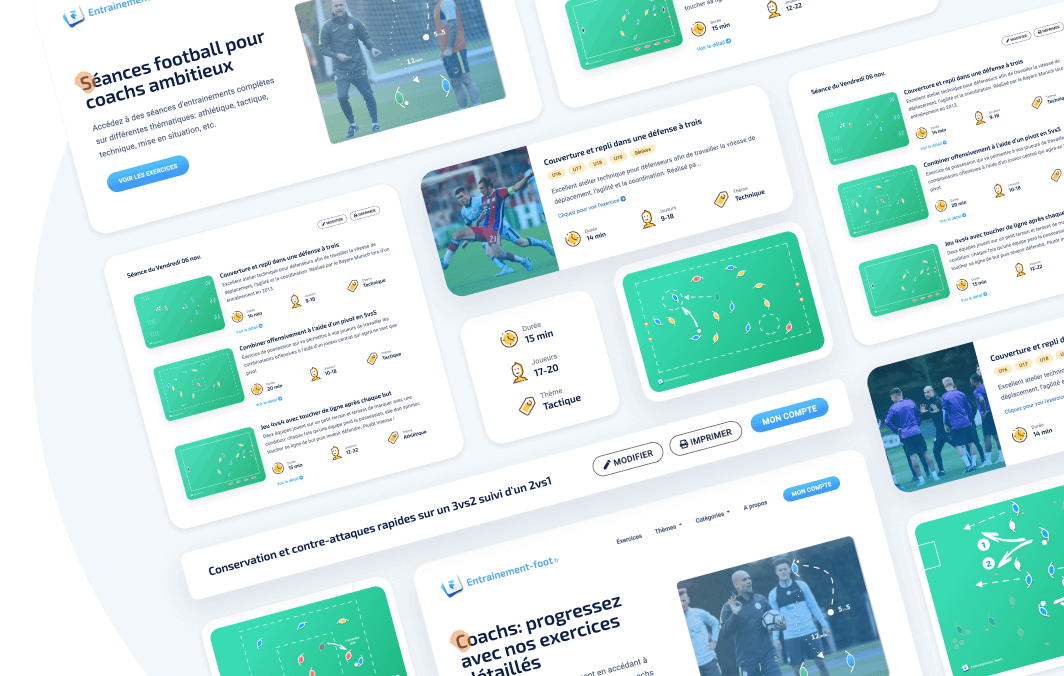
Progress with our drills
Access 500+ premium drills with diagrams inspired by pro coaches. New drills every week.
The main objectives of a U6–U7 session
Unlike older categories, the objectives are not tactical but fundamental. The goal is to build the player’s foundation, both in terms of motor skills and technique.
We usually say that the work should be structured around 5 key areas:
- Development of general motor skills (running, jumping, changing direction)
- First contact with the ball (dribbling, shooting, stopping)
- Coordination and balance
- Discovery of simple game rules
- Socialization (playing with others, waiting their turn, cooperating)
The idea is not to correct every movement, but to encourage experimentation. At this age, the more a child touches the ball, the more they improve.
A key principle: playing time and the number of balls must be maximized.
U6–U7 session: the 5 common mistakes
Many coaches, especially beginners, reproduce patterns adapted to adults or older categories. This can slow learning and reduce enjoyment. Here are the most common mistakes:
1. Exercises that are too complex
At this age, simplicity is essential. Multiple instructions or complicated rules prevent children from understanding and acting.
2. Too much waiting time
Long lines must be avoided. The less a child touches the ball, the less they improve and the more they disengage.
3. Lack of play
Play must be central in every session. A session without opposition or playful situations quickly loses interest.
4. Instructions that are too long
Children only retain a few pieces of information at a time. It is better to give one clear instruction than several objectives at once.
5. Excessive correction
Constantly correcting children can block them. At this age, encouragement is far more effective than precise technical correction.

The coaching principles to respect in U6–U7
Coaching U6–U7 requires a specific approach. The way of teaching is just as important as the content.
The coach must adapt their behavior to maximize children’s engagement.
Some essential principles:
- Use short and simple instructions
- Show the exercises rather than explaining them at length
- Encourage constantly, without focusing on mistakes
- Value successes, even small ones
- Keep a high tempo to avoid downtime
It is also important to vary situations to maintain interest. An exercise that is too long or too complex quickly leads to a loss of attention. A simple rule to remember during your next U6–U7 session: if children are bored, the session must be adjusted immediately.
How to adapt your sessions according to the level and the group
All U6–U7 groups are different. Some children are completely new to football, while others already have some experience.
The coach must be able to adjust training sessions depending on:
- The number of players present
- The overall level of the group
- The energy and concentration of the day
It is often useful to plan simple variations for the same exercise:
- Increase or reduce the space
- Add or remove constraints
- Modify the number of players
Real-time adaptation is a key skill. A good session is not one that follows a perfect plan, but one that adjusts to the children present.
Why the fun dimension is essential in U6–U7
Enjoyment is the main driver of learning in young players. A child who has fun is a child who progresses and wants to come back to training.
Play allows learning without constraint. It naturally promotes:
- Engagement
- Repetition of actions
- Creativity
Introducing stories, challenges, or simple objectives makes U6–U7 exercises more fun and engaging. For example, turning an exercise into a mission or a themed game can immediately capture attention.
At this age, football must remain a game above all. It is this approach that builds motivated players in the long term.