A well-structured training session not only allows you to work on specific objectives, but also places players in situations close to the match. In this complete guide, discover the essential coaching principles as well as a clear structure to prepare your U14–U15 training sessions and support the progression of your team (isn’t that every coach’s dream?).
U14-U15 Training Session : Fundamental Principles
A U14–U15 training session should rely on a few simple but essential coaching principles. At this age, players gradually enter a more structured form of soccer, where understanding the game becomes just as important as technical ability.
We often tell our members that the goal of a U14 or U15 session is not simply to run exercises, but to create situations that allow players to learn, think, and improve in a context that is close to the match.
A Session Focused on the Game
At the U14–U15 level, players should be exposed to situations similar to those encountered in matches. Exercises that are too analytical or disconnected from the game often have little impact on the real development of players.
Learning becomes much more effective when players must make decisions against opponents.
Small-sided games in U15 (and in U14 as well) as well as situations with opposition are particularly useful for developing game understanding.
Working on One Main Objective per Session
A common mistake among coaches is trying to work on too many elements during the same session. The result is that instructions become unclear and players struggle to understand what is actually expected from them.
It is generally better to build the session around one clearly identified main objective.
Here are a few examples of specific objectives:
- improve playing out from the back
- work on ball possession
- develop wing play
- improve collective pressing
Maintaining a Good Level of Intensity
U14–U15 players are capable of sustaining a higher training tempo than younger age groups such as U13. An effective session should therefore maintain a certain level of intensity while still remaining adapted to the level of the group (do not push intensity too far, this is not U19 or senior level yet).
A well-organized session helps reduce waiting time and keeps players active.
To maintain this dynamic, several elements are important:
- prepare the equipment in advance
- limit explanations that are too long
- organize working groups quickly
Encouraging Communication and Cooperation
Soccer is above all a team sport. At this age, players must learn to communicate better and organize themselves on the field. The coach can encourage this dimension by highlighting behaviors such as guiding a teammate under pressure or coordinating defensive movements. This communication helps improve team organization and overall team cohesion.
By applying these fundamental principles, you lay the foundation for a structured, dynamic training session that is truly useful for the development of your U14–U15 players.
Now let’s move on to the key part: how to structure your session.
Ideal Structure of a U14–U15 Training Session (4 Blocks)
To be effective, a U14–U15 training session should follow a clear structure. A logical organization allows players to progressively increase intensity while facilitating learning.
The objective is to move from a warm-up phase to situations that become increasingly close to the match (remember that the ultimate goal is learning while getting closer to match conditions). This pedagogical progression helps players first understand, then apply the principles worked on during the session.
.png)
Most sessions can be organized into four main blocks, each with a specific role in the learning process. A quick note: we advise our coaching members not to be too rigid with these blocks. Some sessions may require adjustments. Consider this structure as a basic working framework.
Block 1: Warm-Up (with the Ball)
The warm-up should not only include physical exercises. At the U14–U15 level, it is preferable to introduce the ball quickly in order to engage players both technically and mentally. This first phase prepares players while immediately placing them in a game-related context.
A good U14 warm-up may include:
- passing while moving
- coordination exercises with the ball
- simple technical games
- low-intensity possession situations
But do not worry, we will come back to this in more detail later.
Block 2: Technical Drills
This second block is often the pedagogical core of the session. The objective is to work on the main goal of the session through a structured situation. Here, the coach aims to repeat a specific game principle in a controlled context.
Here are a few examples of game principles to work on during U14–U15 sessions:
- Working on playing out from the back
- Improving movement to offer passing options to the player in possession
- Developing ball possession under pressure
- Working on defensive coordination
Block 3: Small-sided Games
After the learning situation, it is important to introduce a more open game that allows players to apply the principles worked on earlier. The themed game consists of setting up a small-sided game with specific coaching constraints. These rules guide the game toward the objective of the session.
You can add constraints such as requiring the team to play through the wings before scoring, limiting the number of touches, or using specific zones on the field. These types of constraints help increase intensity, develop decision-making, improve positional play, and encourage certain interactions between players.
In practical terms, block 3 creates a bridge between the pedagogical exercise and the real match.
Block 4: The “Free” Game at the End of the Session
The session usually ends with a “free” game phase. We deliberately put “free” in quotation marks because the game is never truly free. The goal is not to finish with a simple scrimmage, but with a game where players can express what they have learned in a situation close to competition.
Unlike the previous phases, constraints are much more limited here. The objective is to observe whether the principles worked on appear naturally in the game.
During this phase, it is generally recommended to:
- observe player behaviors
- briefly remind players of certain principles
- encourage good decisions
- allow players more freedom to express themselves
By structuring your sessions around these four blocks, you create a logical progression that promotes intensity, game understanding, and the collective development of U14–U15 players.
Example U14–U15 Session to Copy (1h20)
Typical session focused on shooting under pressure
This session can be used for different age groups (U14 to Seniors) and mainly focuses on shooting. It consists of a warm-up, 2 technical drills, and a small-sided game on 3 large goals. You will be able to emphasize the technical aspect during these exercises: sense of positioning, speed of execution, and also the attacking-defensive transition, which should not be overlooked.
#1 Warm-up with the ball, dribbling, and slalom
Themes linked to this drill
#2 Shooting practice with slalom and body feint
- The first 2 players from the same team start simultaneously dribbling to the poles.
- They perform a slalom through the first poles.
- They play a short pass in each other's path, control, and then continue their run with a body feint at the last pole.
- After exiting the slalom, they shoot at the goal.
- At the moment of the shot, the next 2 players from the opposing team start their run.
Themes linked to this drill
#3 Shooting then defensive transition in 3v2
- You will play a short pass to the 1st defender, who will turn and then shoot.
- You will do the same with the 2nd defender. Controlled turn and then shoot.
- Next, you will play into space for the neutral player who will serve as support for the 2 attacking players entering the field.
- This leads to a 3vs2 on the large goal.
- When the ball is recovered or a goal is scored, the attacking team then takes the place of the 2 defensive players.
- The drill continues in the same manner with a new pair of players.
Themes linked to this drill
#4 Positional play and movement in 9v7 on 3 goals
Defending 3 goals will require the defensive team to move and shift more quickly than in a more traditional game. For the offensive team, this setup will make the task less complicated and it should be easier to find players in the channels.
Note: if you do not have 3 goalkeepers available, you can limit to one main goal with a goalkeeper and 2 small goals on the sides. Players will have the opportunity to score on the small goals with one-touch play.
Themes linked to this drill

Progress with our drills
Access 500+ premium drills with diagrams inspired by pro coaches. New drills every week.
Understanding the Challenges of the U14–U15 Age Group
The U14–U15 category represents an important stage in the development of a young soccer player. Players begin to better understand the game, team organization, and the roles of each position. Training sessions must therefore gradually evolve toward a more structured form of soccer, where reflection and decision-making play a greater role.

At this age, the coach’s objective is to support the transition between pre-development age groups and a more mature style of play.
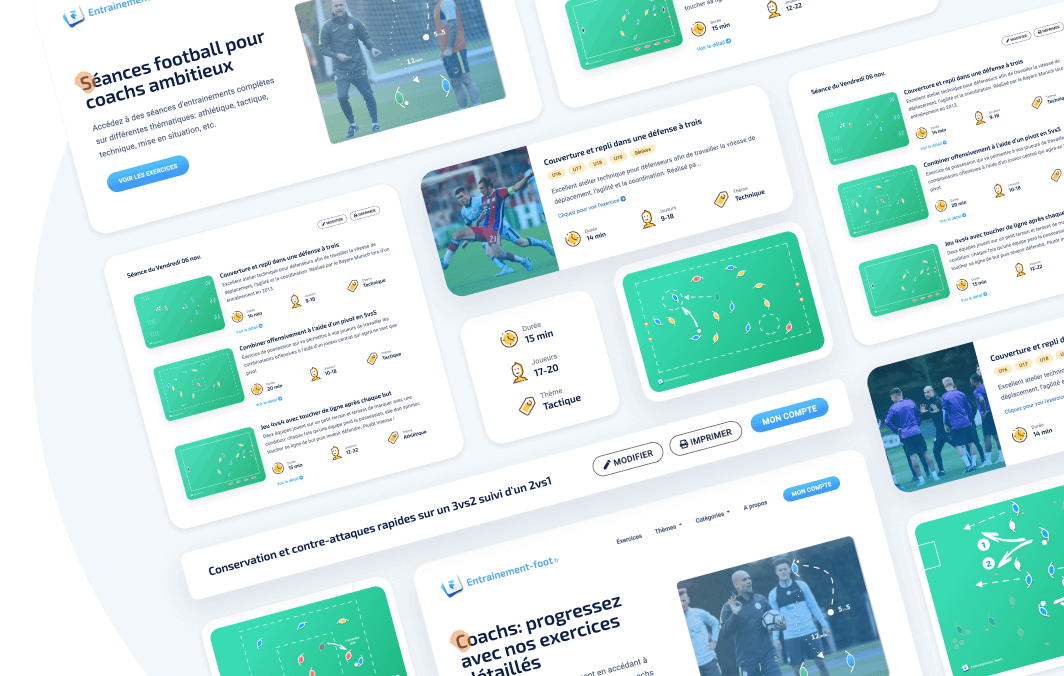
P.S.: And if you’re wondering what the illustration above represents, it is simply your player’s profile from your Soccer Coach Lab account. You can track all of their stats throughout the season and apply the advice from this guide as your training sessions progress.
A Greater Tactical Progression
Good news for the more tactically minded coaches: at the U14–U15 level, players become capable of understanding more advanced collective principles. They start to read situations better and organize themselves on the field. Training exercises should therefore encourage this understanding of the collective game.
From our experience, several concepts become central:
- space occupation (width and depth)
- movement to provide options for the player in possession
- coordination between lines
- management of attacking and defensive phases
Increasing Intensity and Commitment
The pace of the game also increases in this age group. Duels become more intense and game situations unfold faster than in younger categories.
Training sessions must therefore reflect this reality. It is important to include more situations with opposition, dynamic small-sided games, and exercises that resemble match conditions.
The objective is to progressively prepare players for the demands of soccer at higher levels, where intensity, speed of decision-making, and commitment in duels become increasingly important.
Developing Game Intelligence
U14–U15 players begin to analyze their environment more effectively. They are able to gather information before acting and choose between several solutions.
The session you propose to your players should therefore encourage:
- scanning before receiving the ball
- anticipating movements
- quick decision-making
Key Coaching Elements to Master
For a U14–U15 training session to be effective, the coach should rely on a few simple coaching principles (which we will detail a little further below, so no need to rush). At this age, players understand the game better and can integrate more precise instructions, as long as they remain clear and focused.
Giving Simple Instructions
Explanations should be short and straight to the point. The objective is to focus players’ attention on one specific element.
We often share a few rules with our coaching members to remind them that a good instruction should:
- remind players of the objective of the exercise
- be simple and concrete
- focus on 1 or 2 key elements
Observe Before Correcting
The coach should take time to observe the game before intervening. Corrections must be targeted in order to help players improve without breaking the rhythm. Most coaches have experienced this at the beginning: by correcting too much, you end up disrupting the rhythm of the exercise you set up yourself.
Building a Logical Progression
Exercises should progressively evolve toward situations that resemble the match.
This can involve:
- more opposition
- a different playing space
- adapted coaching constraints
Common Mistakes in U14–U15 Training Sessions
Even with good intentions, some mistakes regularly appear in the organization of U14–U15 training sessions. We have all been there, which is why we have prepared a short list of common mistakes along with possible solutions.
These issues can limit player learning or reduce the effectiveness of training. Identifying them helps adjust your sessions and create a more relevant learning environment.
Exercises Too Far Removed from the Game
A common mistake is to propose exercises that are too analytical and not directly connected to match situations. As mentioned earlier in this guide, if players do not understand how to transfer what they learn into the "real" game, their progress becomes limited.

It is therefore better to prioritize:
- situations with opposition
- small-sided games
- exercises close to match situations
Too Many Objectives in the Same Session
Trying to work on too many elements at the same time is another common mistake. Players then struggle to understand what is truly important. An effective session is generally built around one clearly identified main objective.
Examples of session objectives include:
- improving ball possession
- working on playing out from the back
- developing collective pressing
Too Many Corrections During Play
Teaching means repeating. That is why this feedback is worth repeating: constantly correcting players can disrupt the rhythm of the exercise. Interventions should remain targeted so that the game is not interrupted unnecessarily.
The objective is to guide players while still allowing them to experiment and find solutions.
Conclusion
Organizing an effective U14–U15 training session requires structure, clarity, and a good understanding of the needs of players at this age.
By building your sessions around a clear objective, prioritizing situations close to the match, and maintaining a good level of intensity, you support the technical, tactical, and collective development of your team.
A well-structured session allows players to learn, think, and most importantly enjoy playing. This balance between challenge and enjoyment is often the key to a successful training session.