Building a women’s soccer training session is not about taking a standard session and applying it as-is. In practice, coaching a women’s team mainly requires adjusting workload, coaching approach, progression, and how you get players to buy into the session.
Good news: you don’t need to reinvent everything. A clear structure, well-defined objectives, and consistent drills already provide a strong foundation. From there, the key is adapting this base to your group, their level, and their real needs on the field.
The Ideal Structure of a Women’s Training Session (6 Blocks)
To be effective, a women’s soccer training session should follow a simple, clear, and repeatable structure. This backbone helps you save time, reassure players, and build intensity at the right moments.
Here is a structure in 6 blocks that works very well in most contexts:

Block 1: Arrival and Briefing (5 minutes)
From the start, the coach sets the framework. The objective of the day, the main structure of the session, and the expected level of intensity should be clearly communicated. This short mental preparation helps players enter the session more focused.
It is also the moment to quickly assess the group: fatigue, minor injuries, mental readiness, and attendance. This initial reading helps you adjust the workload if needed.
Block 2: Warm-up with Integrated Prevention (15–20 minutes)
This is a key block. In a women’s soccer session, the warm-up should not be treated as a formality. It must prepare the body for effort and secure the rest of the session.
You can include:
- general activation
- dynamic mobility
- footwork and coordination
- active core work
- decelerations, changes of direction, and landings
- a progressive link with the ball
The main focus is execution quality. It’s better to do fewer exercises well than many poorly executed ones. This block should already create focus and intensity without unnecessary fatigue.
Block 3: Technical Activation with the Ball (10–15 minutes)
After physical preparation, it’s time to increase intensity with the ball. This phase helps players reconnect with perception, coordination, and decision-making.
Depending on your theme, you can work on:
- passing quality
- first touch direction
- small group play (2v2, 3v3)
- movement after passing
- scanning before receiving
This block bridges the warm-up and the main part of the session. It also builds engagement: players touch the ball, reconnect with the game, and increase intensity naturally.
Block 4: Main Focus (20–25 minutes)
This is where your main objective is trained. Whether it’s possession, finishing, transition play, pressing, or using wide areas, this is where the core work happens.
The 3 Criteria of a Good Drill
A good women’s soccer drill should meet three criteria:
- it is linked to a clear objective
- it includes real game logic
- it provides intensity adapted to the group’s level
The key here is to avoid overly rigid drills. Players must be able to read the game, make decisions, and understand success and failure. Overly scripted drills may feel productive but often transfer poorly to matches.
Block 5: Conditioned Game or Match-Like Situation (15–20 minutes)
This phase allows players to apply the theme in a more open context. The coach maintains a direction but gives more freedom for decisions, mistakes, and adaptations.
This is often where you see if the session has been effective:
- Are the expected behaviors visible?
- Do players recognize the right triggers?
- Are the coaching points appearing in the game?
The coach’s role is to correct without breaking the rhythm. A short, well-timed intervention is often more effective than constant stoppages.
Block 6: Cool Down and Feedback (5–10 minutes)
This final block is often underestimated but very valuable. It helps properly close the session. You can include a light cool-down, some active stretching if needed, and especially a short group discussion.
The goal is to highlight:
- what worked well
- what needs improvement
- what to carry into the next training or match
This moment helps players retain information, reflect, and give meaning to the session.
Ready-to-Use Women’s Soccer Session (1h20)
Explosiveness: quick transitions and high-intensity duels in the final third
This session focused on explosiveness combines technical work (dribbling, ball control, passing) and real game situations, allowing players to develop their quickness while maintaining high intensity in duels and attacking transitions.
#1 Dynamic Warm-up with Passing, Slalom, and Dribbling

- Variation 1: Players dribble, pass between the poles, then pass the ball to their teammate (along with the pinnie).
- Variation 2: Players start with a dribble, go around a pole, then finish with a pass to their teammate, always passing the pinnie along.
- Variation 3: Players make a pass between the 2 poles, then sprint to their teammate to give them the pinnie. The next player can only make their pass after receiving the pinnie.
- Variation 4 (see main diagram): Players make a pass, then sprint and slalom between the poles before giving the pinnie to their teammate.
Themes linked to this drill
#2 Dribbling and Shooting in a Speed and Precision Circuit

Themes linked to this drill
#3 3v3 with 4 supports and a central player

- The 3-player teams must keep the ball as long as possible but only score a point when the central player touches the ball.
- The corner players serve as support for the team in the offensive position.
- The corner players as well as the support players are only allowed one touch of the ball.

Remember to adjust the number of zones based on the number of players present at practice. If you have a group of 20 players, for example, you can create 2 zones and perform the exercise simultaneously in each zone.
Themes linked to this drill
#4 Small-sided game in 7v7 + 2 floaters and wide players


Themes linked to this drill
Coaching a Women’s Team: What Really Changes
Many coaches coming from the men’s game ask the same question: should you coach a women’s team differently? The answer is simple: yes, but not for the reasons people often think.
The goal is not to fall into clichés or assume players are “less” of something. However, certain concrete specifics must be considered when planning your sessions. This is what allows you to be more relevant, more accurate, and often more effective.
Physical Prevention Must Be Taken Seriously
The first important reality: physical prevention must be carefully addressed. Many female players tend to have greater joint laxity, which can increase the risk of sprains or ligament injuries, particularly in the knee.
This doesn’t mean reducing intensity or coaching with fear, but rather that warm-ups, changes of direction, footwork, landings, and preventive strength work must be properly designed.
In practical terms, a well-structured women’s soccer session should include real neuromuscular preparation, such as:
- activation
- coordination
- stability
- functional mobility
- running mechanics
- special attention to movement quality
Too many coaches still neglect this part or rush through it to “save time.” In reality, this is often where the quality of the rest of the session is determined.
Clear and Useful Communication
Second point: the coach’s communication has a huge impact. In many women’s teams, the quality of the coaching relationship plays a major role in player engagement. Players often need to understand the purpose of the drill, its link to the game, and the objective behind it.
A vague, overly authoritarian, or disconnected message can quickly reduce engagement. This doesn’t mean explaining everything for ten minutes. On the contrary, you need to be clear, precise, and practical.
In a women’s soccer session, a good instruction is generally:
- short
- logical
- immediately applicable on the field
Which is true in both men’s and women’s soccer.
What is often observed is that the more players understand why they are doing a drill, the more fully they commit to it.
Motivation, Engagement, and Group Management
Motivation often works differently as well. In many amateur and semi-professional contexts, players come to training after a long day, sometimes with less background in pure athletic training compared to some male pathways.
Engagement therefore depends heavily on the quality of the content: tempo, ball involvement, game-based situations, purpose, and variety. A session that is too theoretical or too disconnected from soccer quickly loses effectiveness.
Finally, group management requires nuance. In a women’s team, as in any team, the relational climate strongly impacts performance. Trust, cohesion, feeling valued, and being listened to can have a very concrete effect on four elements:
- intensity
- initiative
- individual progression
- collective commitment
In summary, what really changes is not the game itself. It’s the priorities in how the session is built: more prevention, more progression, more clarity, and a stronger link between drills and match reality.
How to Adapt the Session by Level and Age Group
The base structure remains relevant across most categories. However, content, duration, instructions, and workload must evolve depending on the players’ age and level.
U13: Focus on Learning
At U13 level, the priority is learning. A women’s soccer session should be dynamic, fun, easy to understand, and rich in repetitions with the ball.
The goal is to develop:
- coordination
- technical fundamentals
- confidence
- enjoyment
Instructions should be short, situations easy to understand, and waiting time minimized.
U17: More Demands and Game Understanding
At U17 level, you can increase demands. Players are more capable of understanding team concepts and handling more intense training sequences.
Training can include more:
- tactical work
- game reading
- athletic demands
- team structure
As long as progression remains consistent. This is often a key development stage where coaching quality makes a major difference.
Seniors: Efficiency and Game Model Alignment
At senior level, the challenge is twofold: perform immediately and maintain performance over time. Sessions can be more specific, more intense, and closely aligned with the team’s playing style.
However, managing fatigue, injuries, daily life constraints, and group diversity becomes essential. A senior women’s team rarely needs “spectacular” sessions—it needs effective, controlled, and game-relevant sessions.
The 4 Key Variables to Adjust
In all cases, prioritize adapting:
- instruction complexity
- field size
- effort duration
- level of opposition
This is where session quality is often determined—more than by finding “original” drills.
Common Mistakes to Avoid When Coaching a Women’s Team
Some mistakes appear frequently, especially among coaches who simply replicate what they experienced in men’s soccer.
Too Much Physical Work Without the Ball
This is probably the most common mistake. Many players engage better with physical work when it is integrated into soccer situations. Long running or isolated conditioning blocks can quickly reduce motivation.
Neglecting Prevention
Rushing the warm-up, ignoring footwork quality, or neglecting decelerations and direction changes is unnecessary risk-taking. A good women’s soccer session protects as much as it develops.
Giving Too Many Instructions
Trying to correct everything often overwhelms players. One main coaching point, possibly one secondary point, and simple cues are usually enough to generate real progress.
Confusing Intensity with Chaos
An intense session is not a disorganized one. The tempo should be high, but with purpose, precision, and structure.
Using the Wrong Tone
Being patronizing or, on the contrary, artificially harsh is a common mistake. A women’s team does not need special treatment—it needs high standards, respect, consistency, and competence.
Forgetting the Link to the Game
Too many drills are chosen because they “work well,” not because they serve the game model. Every women’s soccer drill should answer one simple question: what should my players do better in matches thanks to this exercise?
Going Further: Women’s Soccer Drills with Diagrams
Preparing a good session is easier when you have access to clear, varied drills designed for the field. To go further, you can rely on a complete library of women’s soccer drills with diagrams, objectives, and simple instructions.
Progress with our drills
Access 500+ premium drills with diagrams inspired by pro coaches. New drills every week.
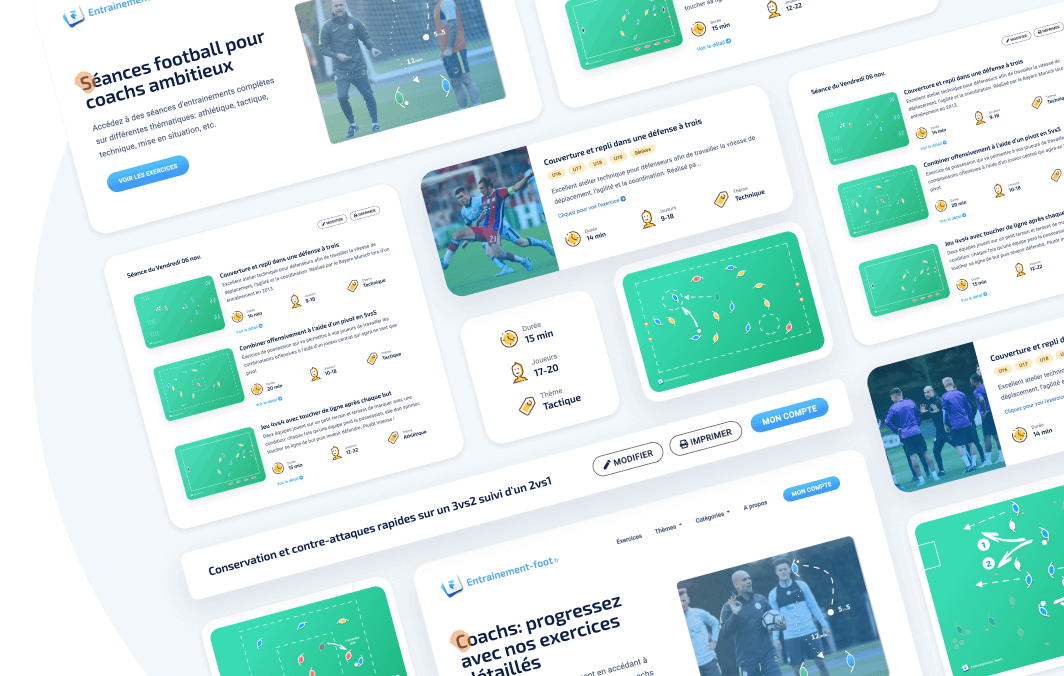
You will find:
- theme-based drills
- situations adapted to youth and senior levels
- easy-to-implement content
- ideas to refresh your sessions without losing consistency
This is the best way to save time, diversify your content, and build coherent training sessions aligned with your category, your theme, and your team’s level.